Automated Demo Videos for Developers: Stop Recording, Start Shipping
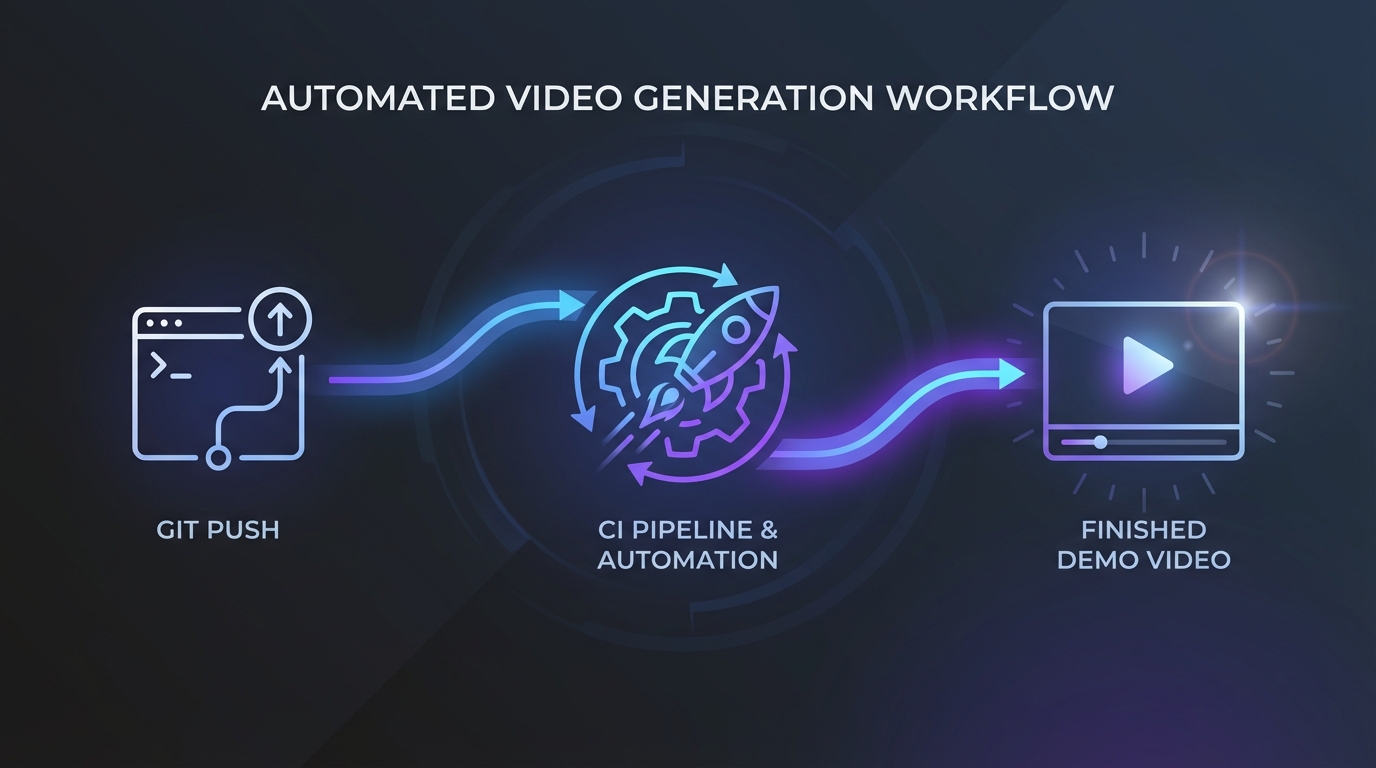
You just shipped a killer feature. The code is clean, the tests pass, the PR is merged. You tag a release. Now comes the part every developer dreads: marketing it.
You need a demo video. Screenshots. A blog post. Social media content. Maybe a release email to your users. You open Loom. You fumble through the UI. You say "um" fourteen times. You forget to show the most important part. You re-record three times, finally settle for "good enough," and upload something that makes your beautiful feature look like a homework assignment.
Then you still need to write a blog post, craft tweets, and email your users. Sound familiar? You're not alone.
The Marketing Problem Nobody Talks About
Here's the thing: marketing collateral is some of the highest-converting content for any software product. Demo videos increase landing page conversions by up to 80%. Blog posts drive organic traffic. Social content keeps you visible. Investors want to see it all. Users expect it. Product Hunt listings need it.
But developers aren't marketers. And they shouldn't have to be.
The traditional workflow looks like this:
- Ship your feature and tag a release
- Open a screen recorder for a demo video
- Script what you're going to say (or don't, and wing it)
- Record yourself clicking through the app
- Realize you messed up at the 2-minute mark — start over
- Edit out the awkward pauses, export, compress, upload
- Take screenshots of the new features
- Write a blog post about what changed
- Craft social media posts for X and LinkedIn
- Draft a release email to your users
- Repeat next sprint
That's easily 2-4 hours per release. For a solo developer or small team shipping weekly? That's a full day every month spent on marketing instead of code.
What If Your GitHub Releases Generated Marketing For You?
Imagine this: you tag a GitHub release, and five minutes later a complete marketing package lands in your dashboard. A polished demo video. Key screenshots. A feature graphic. An SEO-optimized blog post. Social media posts ready to publish. A release email ready to send.
No recording. No editing. No writing. No "let me just reshare my screen real quick."
That's exactly what LaunchStation does. It listens for GitHub release webhooks and automatically generates a full release package — everything you need to market what you just shipped.
Here's what's happening under the hood:
- Read your GitHub release — title, body, and linked PRs to understand what changed
- Generate a demo video (up to 1 minute) — a clean walkthrough with AI narration, transitions, and branding
- Capture key screenshots — AI selects the 1-2 most impactful frames from the walkthrough
- Create a feature graphic — a stylized header image generated via AI, perfect for social sharing
- Write an SEO-optimized blog post — hosted at
<project>.launchstation.dev, ready to share - Draft social media posts — optimized for X and LinkedIn, auto-published on paid tiers
- Compose a release email — ready to send via Resend on paid tiers
The result? A complete marketing package that would've taken you half a day, produced in under 5 minutes with zero effort on your part.
Who Actually Needs This?
If you're reading this, probably you. But specifically:
Indie developers and solopreneurs — You're already wearing every hat. Marketing shouldn't require video production, copywriting, and graphic design skills on top of everything else.
Open source maintainers — Your README has a wall of text where a 60-second demo video and a feature graphic should be. Contributors, sponsors, and users would understand your project 10x faster with visual assets.
Small dev teams — Your PM keeps asking for "a quick video and blog post about the new feature" for the changelog. Automate it all and reclaim your sprint.
Vibe coders — You ship fast and break things. Your marketing should keep up with your velocity.
How LaunchStation Does It
Full disclosure: we built LaunchStation to solve this exact problem. Here's how it works:
- Connect your repo — GitHub integration takes about 30 seconds
- Tag a release — Create a GitHub release like you normally would
- Get a release package — LaunchStation reads your release, walks through your app, and generates a complete marketing package: demo video, screenshots, feature graphic, blog post, social posts, and release email
No screen recording software. No video editing timeline. No blog draft. No Canva session. No "let me just do one more take."
The demo videos include smooth transitions, professional voiceover, and your branding. The blog posts are SEO-optimized and hosted at your own subdomain. Social posts are auto-published to X and LinkedIn on paid tiers. Drop it all on your landing page, share it in your changelog, distribute it everywhere — whatever you need.
Pricing starts at free - 2 lifetime releases at $0 gets you the demo video plus social copy (screenshots, feature graphic, blog post, and email are generated as locked previews to show you what you're missing). The Indie plan ($19/mo) gives you 3 releases per month with the full package, and Pro ($59/mo) covers 12 releases with custom branding via Brand Kit. For most indie developers shipping bi-weekly, the Indie plan is the sweet spot.
But Wait, What About Loom/Arcade/Supademo?
Great tools, different problem.
Loom requires you to manually record. It's a screen recorder with nice sharing features — but you're still the one clicking through the app and talking. And it only gives you video — no screenshots, no blog post, no social content.
Arcade and Supademo create interactive product tours. Useful for onboarding, but they're click-through simulations, not actual marketing content you can embed, share, or publish.
LaunchStation is the only tool that generates a complete release package automatically from your GitHub releases. Demo video, screenshots, feature graphic, blog post, social posts, and release email — all from a single webhook. No manual recording, no click-through building, no editing, no writing. Ship code, get marketing.
The ROI Math
Let's be real about the numbers:
- Average time to create marketing assets for a release: 2-4 hours (video recording/editing, screenshots, blog post, social posts, email)
- Average developer hourly rate: $75-150/hour
- Releases per month needing marketing: 2-4
That's $300-$2,400/month worth of developer time burned on marketing. LaunchStation's Pro plan is $59/month. You'd save money even if you only skip one release cycle.
And that's just the direct cost. The indirect cost of not having marketing collateral — lower conversion rates, harder-to-understand features, weaker Product Hunt launches, no SEO presence — is even bigger.
Getting Started
If you've read this far, you probably have a feature sitting in production right now that deserves a proper marketing push.
Here's what to do:
- Sign up at launchstation.dev — free tier, no credit card
- Connect your GitHub repo — takes 30 seconds
- Tag your next release — and watch the marketing package appear
Your first release package is free. If it saves you even one afternoon of recording, writing, and designing, it's already paid for itself.
Stop recording demos. Stop writing blog posts manually. Start shipping them.
LaunchStation generates complete marketing packages automatically when you tag a GitHub release — demo video, screenshots, feature graphic, blog post, social posts, and release email. Built for developers who'd rather write code than do marketing. Try it free →